Baykar Bayraktar TB2
Baykar's Bayraktar TB2 destroyed Russian armor in Ukraine in 2022. 27-hour endurance, laser-guided MAM-L missiles, sold to 30+ nations. Specs & combat history.
Full Specifications
| Weight | 650 kg (MTOW) |
| Flight Time | 27 h |
| Max Speed | 222 km/h |
| Camera | EO/IR system: optical + thermal + FLIR + laser designator |
| Payload | 55 kg (external) |
| Wingspan | 12 m |
| Wind Resistance | Operations up to 74 km/h winds |
| GPS | GPS + inertial navigation system |
| Dimensions | Length: 6.5 m |
When the war in Ukraine began in February 2022, a Turkish-made drone became a symbol of resistance: the Bayraktar TB2. Videos of successful strikes against armored vehicles, air defense systems, and Russian vessels circulated on social media alongside a popular Ukrainian song dedicated to the drone. Within weeks, the TB2 had moved from a niche subject for defense specialists to broadly known.
The phenomenon reflects a real shift in modern warfare: medium-cost drones gained the ability to destroy equipment costing tens or hundreds of times more than themselves.
What Is the Bayraktar TB2
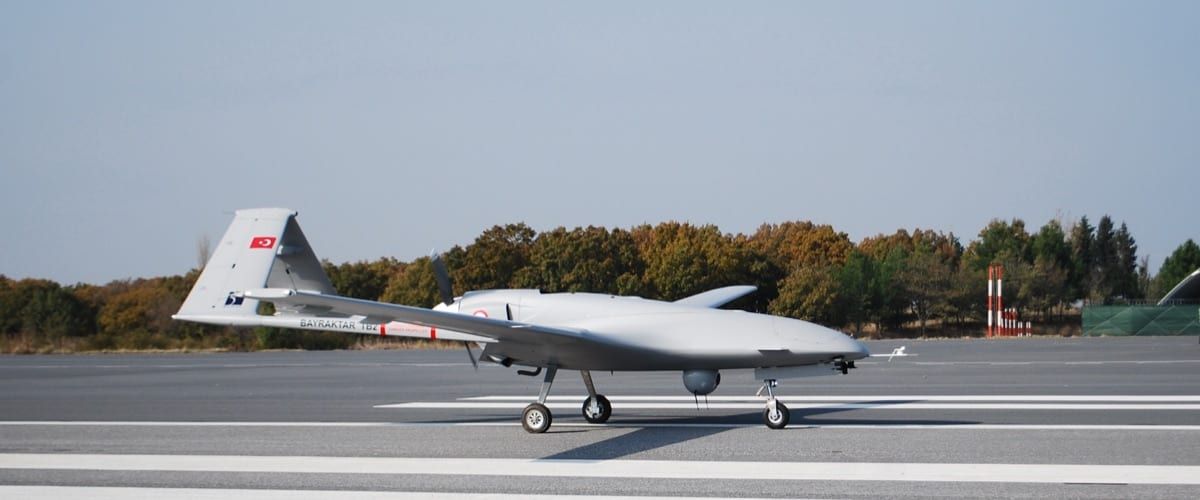
The Bayraktar TB2 is a tactical unmanned combat aerial vehicle (UCAV) developed by Baykar Defense, a Turkish private aerospace company, with operational service beginning in 2014 with the Turkish Armed Forces. It is a medium-altitude, long-endurance (MALE) drone powered by a 100 hp Rotax 912iS piston engine, with a 12-meter wingspan and a maximum takeoff weight of 650 kg.
The TB2 flies at altitudes up to 7,600 meters, an operational ceiling well above the range of most portable MANPADS air-defense missiles, and remains airborne for up to 27 hours per mission.
It is not autonomous: the TB2 is remotely piloted from a ground control station, with two operators: one for flight and one for the sensor/weapons system. Satellite communication provides control beyond line-of-sight range.
Armament and Precision Munitions
The TB2's combat capability comes from the MAM (Micro Munition) family of laser-guided missiles developed by Roketsan:
- MAM-L (Micro Munition Akıllı, "smart micro munition"): 22 kg warhead with thermobaric, high-explosive, or anti-armor options; 8 km range
- MAM-C: lighter (6.5 kg total), for precision strikes against light vehicles and personnel
- MAM-T: extended range (15+ km) version in development
The drone carries four external weapons stations (two per wing) supporting up to four munitions. Laser designation occurs from the onboard EO/IR system, enabling self-designation without a separate ground-based laser, a significant operational advantage.
EO/IR Surveillance System
The nose-mounted WESCAM MX-15D sensor suite (or the Turkish-made Aselflir equivalent) provides: stabilized color optical camera, thermal imager, laser rangefinder, and laser designator. This system operates at altitudes that make the drone difficult to see or hear from the ground, enabling persistent surveillance of a target before engagement.
Conflicts Where It Has Been Used
The TB2 has accumulated operational experience across multiple conflicts since 2019:
- Libya (2019–2020): Operated by the Government of National Accord (GNA) against forces loyal to Khalifa Haftar. This was the TB2's first large-scale operational use.
- Nagorno-Karabakh (2020): Azerbaijan used TB2s to destroy Armenian air-defense systems and armored vehicles over 44 days of conflict. The outcome was studied closely by militaries worldwide as an early demonstration of drone warfare's disruptive potential.
- Ukraine (2022–present): Operated by the Ukrainian Armed Forces since the start of the Russian invasion. The early months showed high effectiveness; over time, improvements in Russian air defense limited operational use, though the TB2 continues to fly specific missions.
Why Ukraine Changed Everything
Before Ukraine, the TB2 was best known from theaters with limited or degraded air defenses. Ukraine was the first large-scale test against a near-peer military with modern, layered air defense systems, and the outcome was more nuanced than the drone's early viral fame suggested.
The TB2 proved effective in the early phases, destroying significant quantities of Russian equipment before Russia adapted its air defense posture. The lesson observers took from Ukraine was that the TB2 is highly effective against armies with poor air defense coordination, but faces increasing attrition against well-organized modern systems. As of 2024, the TB2's role in Ukraine had shifted from offensive strikes toward maritime surveillance and coordination.
Export Success
The TB2 has been exported to more than 30 countries, including Poland, Morocco, Ethiopia, Azerbaijan, and numerous others. Its export price, approximately $5–6 million per unit including ground control station, antennas, and training, is a fraction of comparable Western systems - by contrast, a single F-35 fighter jet costs an estimated $80–110 million - and makes it accessible to militaries that cannot afford Predator or MQ-9 Reaper-class UCAVs.
FAQ
Sources: Baykar Defense: TB2 Technical Specifications | IISS: Military Balance 2024 | Oryx: Equipment Losses in Ukraine