What Is an FPV Drone? A Guide to First-Person View Flying
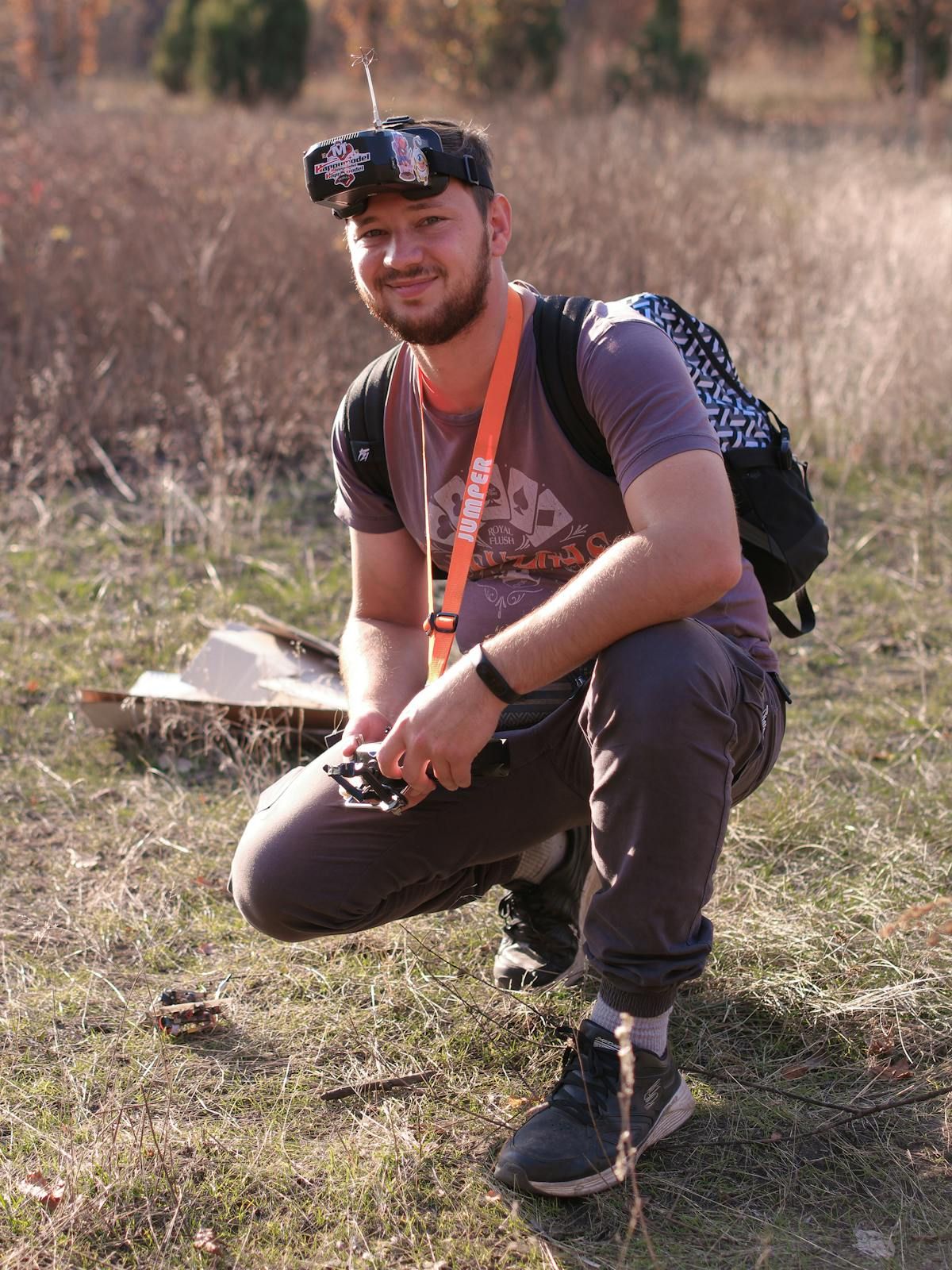
FPV, short for First Person View, is the way of piloting a drone by watching a live video feed from a camera mounted on it - seeing exactly what the drone sees, in real time, instead of watching the drone from the ground.
Imagine seeing the world through the eyes of the drone: not recorded footage, not processed video, but a live feed transmitted directly to your face the instant you're flying. You put on a pair of goggles, and suddenly you're no longer standing in a field. You're in the air.
That sensation of total immersion is what separates FPV (First Person View) flying from every other form of drone operation. It completely transforms the experience, whether you're chasing the pure adrenaline of high-speed racing, executing acrobatic freestyle maneuvers, or capturing cinematic shots that no other tool can produce.
What FPV Means and How It Started
FPV stands for First Person View. The concept is straightforward: a camera mounted on the drone transmits a live video feed to a pair of goggles the pilot wears on their face. From the pilot's perspective, it's as if they're physically inside the drone, seeing exactly what the camera sees, in real time.
The practice began in the RC aircraft community in the late 2000s, when hobbyists started mounting cheap cameras and analog video transmitters on fixed-wing models. The experience was rudimentary, with noisy image, high latency, and limited range, but the potential was immediately obvious. As quadcopters became popular and electronic components improved, FPV evolved quickly from a hobbyist experiment into a technically demanding discipline with professional competitions, sponsored pilots, and global audiences.
Understanding FPV drones today means understanding a distinct ecosystem of hardware, culture, and community that exists largely parallel to the consumer drone world of DJI Phantoms and Minis, with little overlap.
How Real-Time Video Transmission Works
The technical core of FPV is ultra-low-latency video transmission. The goal is for the pilot to see the image almost at the exact moment it's captured, since any significant delay makes flight unpredictable and dangerous.
Traditional analog systems, still widely used because of cost, operate in the 5.8 GHz band and achieve latencies of under 28 milliseconds. That's tolerable for precise flying, but image quality is modest: SD resolution, prone to interference, with the characteristic visual noise (known as "snow") when the signal weakens.
Modern digital systems changed the game. DJI's FPV Air Unit and O3 system operate with latencies of under 5 milliseconds and transmit Full HD video without the interference issues of analog systems. The Walksnail Avatar system from Caddx and the HDZero system are digital alternatives that have also earned a place in the FPV community, each with distinct characteristics around latency, image quality, and hardware compatibility.
The practical difference: with analog, you fly well but accept visual limitations. With digital, the immersion is dramatically greater, and image quality approaches what you'd actually see in a real flight.
The Three Worlds of FPV: Racing, Freestyle, and Cinematic
FPV is not a single discipline. There are three main branches, each with its own culture, specific hardware, and technical demands.
FPV Racing
Racing is FPV in its most aggressive form. Pilots compete on courses with obstacles, such as gates, poles, and tight turns, chasing the lowest possible lap time. Racing drones are pure speed machines: minimalist carbon fiber frames, powerful motors, and an aerodynamic configuration that prioritizes performance above everything else.
A 5-inch racing drone can reach over 130 mph (210 km/h) in a straight line. The flying experience is completely unlike consumer drones, and pilots must master "acro mode" (no electronic stabilization assistance), where the drone does exactly what the pilot commands, without automatic corrections. The learning curve is steep.
Professional competitions like the Drone Racing League (DRL) and MultiGP organize championships with professional pilots who earn between $10,000 and $100,000 per year in prize money and sponsorships. The DRL broadcasts on TV channels and streaming platforms, with growing audiences particularly in the United States and Europe.
FPV Freestyle
Freestyle is the artistic side of FPV. The goal is not maximum speed but executing acrobatic maneuvers with precision and style: power loops (looping at full throttle), split-S turns, low-altitude rolls, passes through tight openings. The aesthetic and the execution are the product.
Freestyle drones are heavier and more durable than racing drones, since equipment longevity matters when each session can involve dozens of crashes. Frames with TPU (flexible polymer) and thicker carbon fiber absorb impacts better. An action camera, typically a GoPro or DJI Action, is mounted to capture the maneuvers, and the edited video is the main output of the discipline.
Freestyle produced most of the viral FPV videos that introduced the format to mass audiences: passes through caves, forest trails, descents down snowy slopes, urban pursuits through tight spaces. The visual impact is immediate and difficult to explain to anyone who hasn't seen it.
Cinematic FPV
Cinematic FPV uses the immersion and agility of first-person flying to create shots that simply don't exist any other way. Unlike a DJI Mavic, which flies smoothly and with a stabilized camera pointing downward, an FPV drone can fly through a window, descend a staircase, skim centimeters above water, and climb vertically in seconds, all in a single continuous take.
Hollywood productions, sports broadcasts, and major brand commercials have incorporated FPV drones as standard production tools. The result is a style of dynamic, immersive footage that audiences recognize, even without knowing it's FPV, by its fluid, seemingly impossible motion.
Cinematic FPV rigs are heavier, carry higher-quality cameras, and are tuned for stability rather than maximum speed. But the piloting principle is the same: the pilot sees through the drone, and the drone goes where the image demands.
The Basic Kit to Start Flying FPV
Getting into FPV requires a more specific set of equipment than buying a consumer drone. There is no "Mavic" equivalent for FPV. You choose, buy, and often build components yourself.
Frame and Flight Components
The frame is the drone's structure, typically carbon fiber for the combination of rigidity and light weight. Size is measured by propeller diameter: 5-inch drones are the most common for freestyle and racing. A complete FPV drone typically weighs between 150 and 350 grams, with flight times of 3 to 8 minutes depending on how aggressively it's flown.
Inside the frame: the flight controller (running firmware like Betaflight or INAV), a 4-in-1 ESC (which controls the motors), and brushless motors (permanent magnet motors with stationary coils and no contact parts, more durable and efficient than brushed motors). A low-latency FPV camera and a video transmitter (VTX) complete the flight package.
The Goggles
The goggles are the interface between pilot and drone, and the most important choice in any FPV setup. There are two main categories.
Analog goggles, like those from Fat Shark and Skyzone, are more affordable, compatible with any analog system, and have minimal latency. They remain the traditional choice and still predominate in the community for their accessibility and the vast availability of compatible hardware.
Digital goggles, like the DJI Goggles 3, Walksnail Avatar, and HDZero, offer radically superior image quality, with HD resolution and controlled latency. The price is significantly higher, but the immersion experience is incomparably better. For pilots who also want to record high-quality images through the goggles feed, the difference is decisive.
The Radio Transmitter
The drone is controlled by a radio transmitter, a specialized remote controller with calibrated joysticks for precise response. Communication with the drone uses a radio protocol, and ExpressLRS (ELRS) has become the community standard by combining ultra-low latency, long range, and accessible cost. Controllers like the RadioMaster TX16S, the Boxer, and the TBS Tango 2 are the most widely used today.
The learning curve starts here. Flying in acro mode on a PC simulator (like Velocidrone or Liftoff) before flying a real drone is standard practice in the community and saves a lot of money on crashes.
A basic functional FPV setup in the US runs from roughly $400 to $1,200, depending on component choices and goggle category.
FPV at the 2026 Milan-Cortina Winter Olympics
FPV entered the mainstream definitively when the 2026 Winter Olympics in Milan-Cortina adopted immersive piloting drones as an official broadcast production tool. Fifteen FPV drones were used to capture images inside alpine ski, snowboard, and other event courses, shots that conventional cameras in helicopters or on rails could never replicate.
The choice speaks volumes. The Olympics maintains the most demanding production standards in the world. Adopting FPV was not an aesthetic decision. It was a recognition that this technology delivers something no other tool can: the feeling of being inside the action.
The visibility that the Olympics gave FPV is significant. For millions of viewers who had never heard the term, those images were their first experience of what immersive piloting drones can do.
How to Get Started in FPV
The recommended sequence for anyone wanting to enter FPV:
1. Simulator first. Before buying any hardware, install an FPV simulator on your PC. Velocidrone and Liftoff are the best options. Connect a compatible controller and spend at least 20 hours practicing acro mode in the simulator. This will save significant money on real-world crashes.
2. Beginner drone. Entry-level options like whoops (65mm micro-drones) are excellent for indoor flying without risk of major damage. They're also how most experienced pilots practice in bad weather. A slightly larger "toothpick" style 2.5-inch build is another great starter for outdoor flying.
3. Complete setup. With basic skills built, assembling or buying a 5-inch drone with digital goggles is the natural next step. The local community is the best guide for component selection, since what's available and priced reasonably varies significantly by region.
4. Open spaces. Practice in open fields, away from people and infrastructure. FPV has a genuine learning curve, and first outdoor flights are challenging even with simulator hours behind you. Real-world experience is irreplaceable.
FPV vs. Consumer Drones: Choosing the Right Tool
FPV and consumer drones like the DJI Mini or Air series are fundamentally different tools for different purposes. A DJI consumer drone offers full electronic stabilization, GPS position hold, automated flight modes, and a camera optimized for photography. An FPV drone in acro mode responds purely to pilot inputs with no automatic corrections, offering agility and an immersive experience that the former cannot replicate.
They are not competitors. They are complementary. Many professional creators own both: a consumer drone for stable aerial photography and a cinematic FPV rig for dynamic, immersive sequences. Understanding what each tool does best is the key to choosing the right one, or building a kit that covers both needs.
The FPV world rewards investment in learning. Unlike consumer drones where competent footage is achievable quickly, mastering FPV takes months of consistent practice. But the creative ceiling is also much higher, and the community of pilots who have made that investment is one of the most welcoming and technically knowledgeable in any hobby.
More like this
Related Articles
Drone Delivery in 2026: How It Works, Cost & Coverage
Drone delivery in 2026: how Amazon, Wing, Zipline, and DoorDash actually work, what deliveries cost, and how to check if the servi…
Is DJI Banned in the US? 2026 Status, Rules and FAQ
DJI isn't fully banned in the US, but new models can't get FCC approval. Here's exactly what's restricted, what's still legal, and…
Drone Pilot Career: Salary, Jobs & Licensing in 2026
US drone pilots earn $47,000-$137,000 in 2026 depending on sector. See real salary data, the industries hiring, licensing costs, a…